Remembering Metropolitan Anthony
.
Today is the 9th anniversary of the repose of Metropolitan Anthony of Sourozh. We offer you the following essay written in 2003 by Jim Forest, International Secretary of the Orthodox Peace Fellowship.
“We should try to live in such a way that if the Gospels were lost, they could be re-written by looking at us.”
– Metropolitan Anthony of Sourozh
One of the significant events in the Orthodox Church this year was the death from cancer on August 4th of a remarkable, indeed saintly, bishop: Metropolitan Anthony of Sourozh. He was 89. For many years he headed the Russian Orthodox Church of the Moscow Patriarchate in Great Britain.
Though he was not a member of the Orthodox Peace Fellowship’s advisory board, Metropolitan Anthony’s letters and conversations with those responsible for OPF played an important role in the path the Fellowship has followed. He passionately believed that peacemaking required active, warrior-like combat with evil. He had a strong aversion to the word “pacifist,” not only because it sounded with “passive-ist” but because of unpleasant encounters with self-righteous people quick to denounce those who failed to share their ideology. He preferred the phase “a man — or woman — of peace” which meant, he explained, a person “ready to work for the reconciliation of those who have grown apart or turned away from one another in enmity.” He was unhesitating in declaring that hatred is incompatible with Christianity, but saw the use of violence against Nazism in the Second World War as a lesser evil.
He sometimes told the story of an encounter he had during a retreat for university students. “After my first address one of them asked me for permission to leave it because I was not a pacifist.” “Are you one?” Metropolitan Anthony replied. “Yes.” “What would you do,” he asked, “if you came into this room and found a man about to rape your girl friend?” “I would try to get him to desist from his intention!” the man replied. “And if he proceeded, before your own eyes, to rape her?” “I would pray to God to prevent it.” “And if God did not intervene, and the man raped your girl friend and walked out contentedly, what would you do?” “I would ask God who has brought light out of darkness to bring good out of evil.” Metropolitan Anthony responded: “If I was your girl friend I would look for another boy friend.”
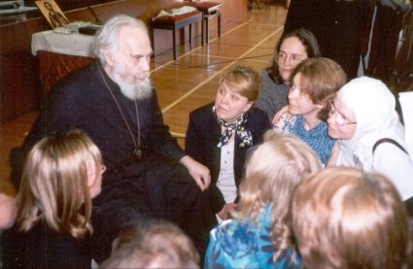
Yet, while hating passivity in the face of evil, his own commitment to reconciliation had deep roots in his life. During the years the German army occupied France when he was a physician active in the Maquis, a section of the French resistance, he had occasion to use his medical skills to save the life of a German soldier. Condemned for this act of Christian mercy by colleagues in the resistance, it was an action which almost cost him his own life. He was nearly executed. It was in that crucible of expected death that he decided, should he survive the war, that he would become a monk. Continuă să citești →
Apreciază:
Apreciere Încarc...
 Biserica Ortodoxă Română îl pomeneşte astăzi pe Sfântul Ioan Iacob de la Neamţ, născut la 23 iulie 1913, în satul Crăiniceni – Horodiştea, din judeţul Botoşani. Cuviosul părinte şi-a început viaţa mănăstirească în lavra Neamţului. De acolo, dorul de sfinţenie l-a adus în Ţara Sfântă, unde a trecut la cele veşnice în peştera din pustiul Hozevei.