Arhive categorii: in English

Why doesn’t the priest look at us, but looks instead to the sanctuary?

‘Why doesn’t the priest look at us, but looks instead to the sanctuary?’


…the Royal Doors open and the priest appears in the sanctuary.

Why, though, doesn’t he look at us, but looks instead to the sanctuary? When the priest stands in front of the altar, he is praying, and imploring, and calling upon Christ as our intercessor. And, afterwards, when the priest make the Entry, he will again pass through our midst without so much as glancing in our direction. It is he who goes ahead of us, who ascends, who leads us on the road to heaven.

What is the significance of this behavior? Why does the priest always go in front of us without looking at us? Pay attention to this in order to understand.

Have you ever been up to the monasteries of Meteora? Have you gone, for instance, to the Monastery of the Great Meteoron? In the old days, people had to be pulled up there in a net. Continuă să citești →

All Saints of Russia

All Saints of Russia


The Day commemorating the saints who have shown forth in the Russian land points to that spiritual heaven beneath which the Russian land was founded and lived. 

Before the holy Prince Vladimir, there lived on the Russian land separate, pagan tribes that warred with one another. The holy Prince Vladimir brought them a new faith, a new consciousness and meaning of life, a new inner spiritual state; he gave them a new spirit of life that united everyone, and thus a single nation was formed. 

The very existence of the Russian nation is tied to the begetting of spiritual life within it, with the assimilation of the fundamentals of a Christian world-view. It is senseless to seek the meaning and purpose of life in earthly life, which ends with death. One must strive to acquire the Divine, grace-filled, eternal life, and then this temporal, earthly life will arrange itself as well: Seek ye first the Kingdom of God and his righteousness; and all these things shall be added unto you (Matt. 6:33). Continuă să citești →

The schismatic so-called “Macedonian Orthodox Church”,is attempting to trade with the sufferings that Archbishop Jovan of Ohrid and Metropolitan of Skopje is undergoing for the unity of the Church

The schismatic so-called “Macedonian Orthodox Church”,is attempting to trade with the sufferings that Archbishop Jovan of Ohrid and Metropolitan of Skopje is undergoing for the unity of the Church


Today (28.03.2013), for the fifth time, the trial of Bishop Marko of Bregalnica, Bishop David of Stobi, two priest-monks, two abbesses and ten layman of the Orthodox Ohrid Archbishopric, who are accused by the state organs of FYROM, together with His Beatitude Archbishop Jovan of Ohrid and Metropolitan of Skopje, for the alleged crime of “money laundering” is postponed! The court is not officially stating for what reason there has not been any court hearing for whole four months, since the last court hearing held on 11.12.2012!

Archbishop Jovan of Ohrid for more than one year is being placed in detention, he has been denied the right to be visited, not even by his mother nor his sister, who have been accused for the same deed. Hence, it is very hard to authentically learn about is his health condition in the current moment. But, from the last contacts we had with him, on the court hearing four months ago, we know that his health has been seriously deteriorated! Continuă să citești →

O delegaţie a Patriarhiei Moscovei în vizită la Patriarhia Română (Ro, En)

O delegaţie a Patriarhiei Moscovei în vizită la Patriarhia Română

*

În ziua de 10 martie 2013, la Reşedinţa Patriarhală, Preafericitul Părinte Patriarh Daniel a primit vizita unei delegaţii a  Patriarhiei Moscovei, condusă de Înaltpreasfinţitul Părinte Ilarion de Volokolamsk, care a participat la festivitatea de întronizare a noului Arhiepiscop al Buzăului şi Vrancei.

În timpul întâlnirii a fost abordată cooperarea dintre cele două Biserici Ortodoxe Surori în ceea ce priveşte învăţământul teologic, prin intensificarea schimbului de bursieri şi organizarea de pelerinaje la locurile sfinte din cele două ţări ortodoxe. Au mai fost discutate diferite aspecte ale relaţiilor dintre Bisericile Ortodoxe Surori şi ale dialogului intercreştin şi interreligios.
Continuă să citești →

Pr. Dr. Dorin Octavian Picioruș: Sermon on Sunday the 20th after Pentecost [2012]


Sermon on Sunday the 20th after Pentecost [2012]

 Pr. Dr. Dorin Octavian Picioruș


My Beloved,

We live in times in which death is very present, for that grinder’s disease. Bites of us the disease of the sin that gives birth the death of soul and of body.

And for that we are too clogged to death, therefore we loose from calculation the resurrection. But the resurrection is absolute for us, for that it keeps of us and preparesthe final, from the coming of the Lord into glory.

Therefore today’s Evangel [Luke 7, 11-16] proposes us to talk about the innerresurrection, about spiritual life, which stays at basis the resurrection of all.

For pity, attention, the help, the responsibility for others are the consequences of an active spiritual life.

And for that they exist we must rise from the dead. Continuă să citești →

Blessed Father Seraphim Rose (audio lectures) on “The End Tines: The Ecumenical Movement, The Apostasy of the Church and The Antichrist”

Blessed Father Seraphim Rose (audio lectures)

on “The End Tines: The Ecumenical Movement, The Apostasy of the Church and The Antichrist”

.

[wpvideo zUwfdrxt]

***

MP3 with Fr. Seraphim Rose:

On The Ecumenical Movement_Signs of the Times I

On the Apostasy of the Church_Signs of the Times II

On the Antichrist

*****

Source: http://orthodoxword.wordpress.com

A Homily on the Dormition of Our Supremely Pure Lady Theotokos and Ever-Virgin Mary

A Homily on the Dormition of Our Supremely Pure Lady Theotokos and Ever-Virgin Mary

by St. Gregory Palamas

Both love and duty today fashion my homily for your charity. It is not only that I wish, because of my love for you, and because I am obliged by the sacred canons, to bring to your God-loving ears a saving word and thus to nourish your souls, but if there be any among those things that bind by obligation and love and can be narrated with praise for the Church, it is the great deed of the Ever-Virgin Mother of God. The desire is double, not single, since it induces me, entreats and persuades me, whereas the inexorable duty constrains me, though speech cannot attain to what surpasses it, just as the eye is unable to look fixedly upon the sun. One cannot utter things which surpass speech, yet it is within our power by the love for mankind of those hymned, to compose a song of praise and all at once both to leave untouched intangible things, to satisfy the debt with words and to offer up the first fruits of our love for the Mother of God in hymns composed according to our abilities.

If, then, „death of the righteous man is honorable” (cf. Ps. 115:6) and the „memory of the just man is celebrated with songs of praise” (Prov. 10:7). How much more ought we to honor with great praises the memory of the holiest of the saints, she by whom all holiness is afforded to the saints, I mean the Ever-Virgin. Mother of God! Even so we celebrate today her holy dormition or translation to another life, whereby, while being „a little lower than angels” (Ps. 8:6), by her proximity to the God of all, and in the wondrous deeds which from the beginning of time were written down and accomplished with respect to her, she has ascended incomparably higher than the angels and the archangels and all the super-celestial hosts that are found beyond them. For her sake the God-possessed prophets pronounce prophecies, miracles are wrought to foreshow that future Marvel of the whole world, the Ever-Virgin Mother of God. Continuă să citești →

Remembering Metropolitan Anthony

Remembering Metropolitan Anthony

.

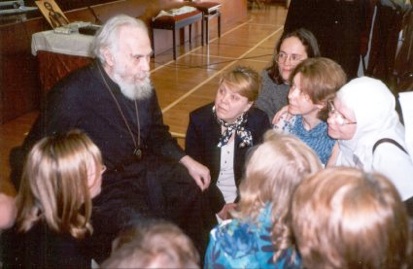
Today is the 9th anniversary of the repose of Metropolitan Anthony of Sourozh.  We offer you the following essay written in 2003 by Jim Forest,  International Secretary of the Orthodox Peace Fellowship.

“We should try to live in such a way that if the Gospels were lost, they could be re-written by looking at us.”

– Metropolitan Anthony of Sourozh

One of the significant events in the Orthodox Church this year  was the death from cancer on August 4th of a remarkable, indeed saintly, bishop: Metropolitan Anthony of Sourozh. He was 89. For many years he headed the Russian Orthodox Church of the Moscow Patriarchate in Great Britain.

Though he was not a member of the Orthodox Peace Fellowship’s advisory board, Metropolitan Anthony’s letters and conversations with those responsible for OPF played an important role in the path the Fellowship has followed. He passionately believed that peacemaking required active, warrior-like combat with evil. He had a strong aversion to the word “pacifist,” not only because it sounded with “passive-ist” but because of unpleasant encounters with self-righteous people quick to denounce those who failed to share their ideology. He preferred the phase “a man — or woman — of peace” which meant, he explained, a person “ready to work for the reconciliation of those who have grown apart or turned away from one another in enmity.” He was unhesitating in declaring that hatred is incompatible with Christianity, but saw the use of violence against Nazism in the Second World War as a lesser evil.

He sometimes told the story of an encounter he had during a retreat for university students. “After my first address one of them asked me for permission to leave it because I was not a pacifist.” “Are you one?” Metropolitan Anthony replied. “Yes.” “What would you do,” he asked, “if you came into this room and found a man about to rape your girl friend?” “I would try to get him to desist from his intention!” the man replied. “And if he proceeded, before your own eyes, to rape her?” “I would pray to God to prevent it.” “And if God did not intervene, and the man raped your girl friend and walked out contentedly, what would you do?” “I would ask God who has brought light out of darkness to bring good out of evil.” Metropolitan Anthony responded: “If I was your girl friend I would look for another boy friend.”
Yet, while hating passivity in the face of evil, his own commitment to reconciliation had deep roots in his life. During the years the German army occupied France when he was a physician active in the Maquis, a section of the French resistance, he had occasion to use his medical skills to save the life of a German soldier. Condemned for this act of Christian mercy by colleagues in the resistance, it was an action which almost cost him his own life. He was nearly executed. It was in that crucible of expected death that he decided, should he survive the war, that he would become a monk. Continuă să citești →

The Son of the Prime Minister of Kenya is Baptized Orthodox

The Son of the Prime Minister of Kenya is Baptized Orthodox

.

July 29, 2012

Metropolitan Makarios of Kenya received about a month ago into the Orthodox Church the first-born son of Prime Minister Raila Odinga, Fidel Castro Odinga (named after the Cuban revolutionary leader), who was accompanied by his then future wife Lwam Getachew Bekele who is half Eritrean and half Ethiopian.

The couple had expressed their great desire for Fidel to join the one, holy, catholic, and apostolic Church.

Having made the necessary arrangements, catechism, etc, His Eminence celebrated the Sacrament of Baptism in the large baptistry of the Orthodox Patriarchal School “Archbishop Makarios III of Cyprus”, baptizing Fidel, together with 22 others, and giving him the name Makarios.

On July 28 His Eminence celebrated Fidel’s and Lwam’s marriage ceremony at the Patriarchal Cathedral Church of the Holy Unmercenaries in Nairobi.

The ceremony was attended by the parents of both newlyweds, and the Metropolitan, in the end, gave fatherly admonitions as they embark on their new journey together.


Source: http://www.pravoslavie.ru

Prayer is the Test of Everything….

Prayer is the Test of Everything….

.

.
„Prayer is the test of everything; prayer is also the source of everything; prayer is the driving force of everything; prayer is also the director of everything. If prayer is right, everything is right. For prayer will not allow anything to go wrong.” — St. Theophan the Recluse.
Perhaps the most popular and basic definition of prayer is that it is a conversation with God. While this is essentially true, Orthodox Christianity looks upon prayer as something deeper than „conversation”.
Prayer is understood as an intimate encounter with God. When we pray, we meet with God in our hearts, in the sanctuary of all our thoughts, motivations, dreams, emotions and concerns. This is a place where we can share our inner selves with no other human person as completely as we can share ourselves with the Lord.
To enter into this very personal and intimate place with God, full of faith and love, is to feel His presence in our lives in the most profound and life-giving of ways. In this place in our hearts, we no longer perceive God as being „out there”, looking down on us. Rather, we sense His presence inside us, stirring our hearts, guiding our actions, enlightening our minds.
Our Orthodox Christian Faith teaches us that prayer is the most natural thing a person can do, it is what we are created for. In Paradise Adam and God converse frequently. It is only after the Fall that we hide from God and choose not to speak openly with Him. Continuă să citești →

Religious perscutions of Christians in the world of Islam

Religious perscutions of Christians in the world of Islam

.

  Pancretan Association of Theologians
Religious perscutions of Christians in the world of Islam

In recent years both the Greek people – but also all those who have access to information media – are being frequently informed of the constantly increasing incidents of religious violence which result in the torture, the killing, or the compulsory expulsion of those fellow-men who convert to Christianity from Islam.

Acts such as these are reminiscent of the dark eras of the past, which all of us had hoped were long gone, never to return again. Unfortunately, apart from all the horrific social and psychological consequences for the societies upon which they are being inflicted, there are also exceptionally negative repercussions on the image of those countries that commit and foster such acts, including the image of their civilization and their religion, in the eyes of the whole world.

During the entire length of Her history, the Orthodox Church has suffered the violence of persecutions innumerable times.  With horror we recall the atrocious martyrdoms of Orthodox martyrs during Greece’s 400 years of Turkish occupation, which are unfortunately very similar to the aforementioned current events. Even during the 20th century, there have been thousands of martyrs – especially in anti-Christian regimes – who have given their lives out of love for Christ and have adorned Orthodoxy’s Book of Saints with their heroism and offering of their life-blood. Continuă să citești →

Holy Synod requests prayers for victims of Colorado shooting

Holy Synod requests prayers for victims of Colorado shooting

*

SYOSSET, NY [OCA]

On the morning of Friday, July 20, 2012, Americans awoke to the tragic news that shortly after midnight, seventy-one innocent people attending a screening of “The Dark Knight Rises” in an Aurora, Colorado theater had been shot by a lone gunman. Ten of the victims died at the scene; two others died in area hospitals.

It goes without saying that at times like these, as we are once again left with a sense of confusion and righteous indignation, our faith is sorely tested. Left with a sense of confusion and righteous indignation, it is reasonable to ask what would possess someone to enter a theater, dressed in black with body armor, and open fire at the audience? Attempting to rationalize an act that, by its very nature can only be termed irrational, is futile. Accepting the fact that such irrational acts do indeed occur, however, reminds us that we indeed live in a fallen world, a world that so desperately needs the Gospel of Jesus Christ, centered as it is on forgiveness and love. Continuă să citești →

Anthony Bloom, Metropolitan of Sourozh – On suffering (Video, English)

Anthony Bloom, Metropolitan of Sourozh – On suffering

(Video, English)

.

What is the sense of suffering in our lives? A talk with Anthony Bloom, Metropolitan of Sourozh (The Eastern Orthodox Church in Britain).

.

*** Continuă să citești →

Spirituality and the Role of a Spiritual Father

Spirituality and the Role of a Spiritual Father

.

The video recording from which this transcript was taken was made almost twenty-five years ago, on May 18, 1987. In those days, in connection with the millennial of the Baptism of Russia, international conferences were held in the Publishing Department of the Moscow Patriarchate. On that day, Metropolitan Anthony (Bloom) of Surouzh appeared with his famous report, “Spirituality and the Role of a Spiritual Father.” His talk was unforgettable for both its essence and the power of its pastoral word.

The videotape of this film that I made after Metropolitan Pitirim had given me my own wonderful video camera was recently unearthed, and I was filming everything I could get my hands on. I needed experience, and that is how this film came into being. The films were somewhat mediocre, but I am just happy that they were preserved.

How is it that this tape was not lost? If I find the time, I will be looking for other interesting films, and I will definitely put them on our website.

Archimandrite Tikhon (Shevkunov)

*   *   *

I should first of all ask forgiveness for not having a text for this talk; am hoping in the prayers of some of you here that this talk will turn out well today.

The theme of my talk is spirituality and the role of a spiritual father, or if you prefer, spiritual nourishment, or care of souls. Continuă să citești →

The Prologue July 4 / July 17

The Prologue July 4 / July 17

.

The Prologue from Ohrid: Lives of Saints by Saint Nikolai Velimirovič for Old Calendar date July 4, and New Calendar date July 17.

1. SAINT ANDREW, ARCHBISHOP OF CRETE

Andrew was born in Damascus of Christian parents. He was a mute from birth until the age of seven. When his parents brought him to church and he received Holy Communion, he began to speak. So great is the power of the Divine and Holy Communion. At age fourteen, Andrew went to Jerusalem and was tonsured in the Lavra of St. Sabas the Sanctified. By virtue of his understanding and asceticism, he surpassed many of the older monks and was an example to them. After a while, the patriarch took him as his personal secretary. When the Monothelite heresy began to rage the heresy which taught that the Lord Jesus did not possess a human will but only a divine will the Sixth Ecumenical Council convened in Constantinople in the year 681 A.D. during the reign of Constantine IV [Bearded One]. Theodore, the Patriarch of Jerusalem, was unable to attend the council but sent Andrew as his representative who, at that time, was an Archdeacon. At the council, Andrew displayed his wonderful gift of oratory, his zeal for the Faith and rare prudence. Having assisted in strengthening the Orthodox Faith, Andrew returned to his duties in Jerusalem. Later, he was elected and installed as the Archbishop of the Island of Crete. As an archbishop, he was greatly loved by the people. Andrew was very zealous for Orthodoxy and vehemently eradicated all heresies. Through his prayers he worked miracles. By his prayers, he drove the Saracens from the Island of Crete. Andrew wrote many books of instruction, hymns and canons of which the most renown is the Great Canon to the Birth-giver of God read on Thursday of the Fifth Sunday of the Great Lenten Season. His outward appearance was such that „seeing his face and hearing his words flowing like honey, everyone found pleasure and amended their ways.” On one occasion, returning from Constantinople, Andrew foretold his death before he arrived in Crete. And so it happened. When the boat in which he traveled sailed near the island of Mitylene, this beacon of the Church ended his earthly life and with his soul, took up habitation in the Kingdom of Christ in the year 721 A.D. Continuă să citești →