Arhive categorii: in English

Starețul Efrem – Rămas bun și arestul preventiv pe nedreptate /The Abbot Ephraim – Farewell Day (SPECIAL PHOTO REPORT) / Ο Γέροντας Εφαίμ – Ο αποχαιρετισμός

Starețul Efrem – Rămas bun și arestul preventiv pe nedreptate/

The Abbot Ephraim – Farewell Day (SPECIAL PHOTO REPORT) /

Ο Γέροντας Εφαίμ – Ο αποχαιρετισμός

[slideshow]

Romanian

Luni seară Sfânta Kinotită (consiliul de conducere a Sf. Munte format din toţi reprezentanţii celor 20 de mănăstiri din Sf. Munte) a descins la Vatoped, prezentând o scrisoare de susţinere la adresa obştii mănăstirii precum şi a stareţului acesteia. Evenimentul a fost unul istoric, pentru prima dată după mulţi ani Sfânta Kinotită se întâlneşte cu obştea unei mănăstiri la ea acasă, într-un astfel de mod.

Membrii Kinotitei şi-a exprimat pe de o parte sprijinul faţă de mănăstirea încercată iar pe de altă parte au dezaprobat arestul preventiv aplicat părintelui Egumen Efrem, o măsură abuzivă ce încalcă atât legile Greciei cât şi pe cele ale Sf. Munte. Adunarea a avut loc fără prezenţa părintelui Efrem care era la chilie, bolnav.

De asemenea Sfânta Koinotită l-a vizitat pe Părintele Stareţ la chilie reasigurăndu-l de sprijinul acesteia precum şi de faptul că se va înainta o scrisoare către Procurorul Curtei Supreme de Justiţie, Ioannis Tendes în care Sfânta Koinotită garantează pentru p. Stareţ Efrem că nu va părăsi mănăstirea.

Pe de altă parte, p. Efrem, cu toate că este bolnav, a decis să se prezinte autorităţilor, pentru a nu da loc la bănuieli şi suspiciuni, chiar şi fără voie (datorită bolii sale) şi chiar dacă este acuzat total pe nedrept.

Luni seara târziu toată obştea s-a adunat în holul neîncăpător de lângă chilia părintelui stareţ (chilia fiind de dimensiuni total neîncăpătoare, aprox. 2.5 x 3 m) pentru a asculta ultimul cuvânt de folos. Atmosfera a fost foarte caldă şi duhovnicească. Cu această ocazie, părinţii i-au pregătit un cadou p. Stareţ: o icoană mică cu Iisus întemniţat.

Marţi dimineaţa înainte de plecare s-a oficiat Paraclisul Maicii Domnului. Continuă să citești →

Sermon on the Birth after the Flesh of the Lord God and Our Savior Jesus Christ [December 25, 2011]

Sermon on the Birth after the Flesh of the Lord God and Our Savior Jesus Christ

 [December 25, 2011]

*

Beloved brothers and sisters into the Lord,

It is foreign born and unusual! For that the Son of God the Son of the Virgin is made…for to deify our human nature.

Many dreamed gods…many had wanted to be worshiped instead of God…but, now, came into the world, as Child, the Creator of the world Himself.

Therefore, Christ came in history imperceptibly…for the only several have noticed of His presence.

The magi and the shepherds come to the Lord…but they have not known the entire humanity of His birth.

And now, after 2.000 years, is need to preach Christ’s Birth because some have forgotten the immense joy of this day…and others do not know at all.

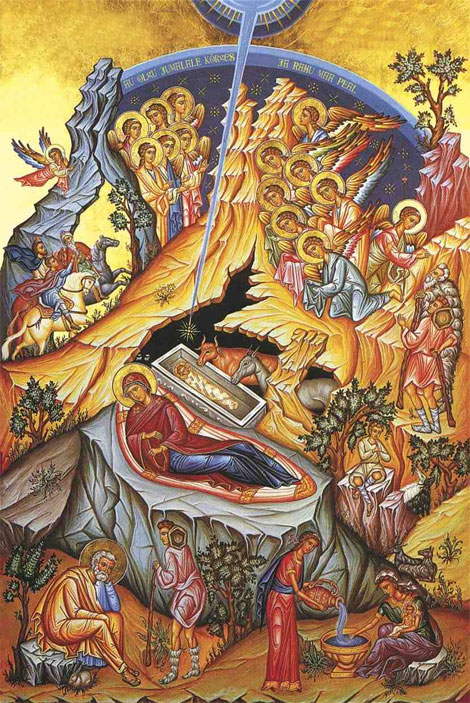
The icon of the feast as and the day’s hymnology show us the fact that His birth, after the body, was real.

For that the Son of God, begotten of the Father before all ages, was incarnate from the Virgin Mary and assumed humanity.

Alike God and man…He, „the unchanged Face of the Father”, „out from the Mother, who knew not the wedding, undergone change”. Continuă să citești →

Sermon on Sunday Before of the Lord’s Birth [2011]

Sermon on Sunday Before of the Lord’s Birth

[2011]

Beloved brothers and sisters into the Lord,

By today’s Gospel [Matthew 1, 1-25], our Church tells us, in pressed mode, that Christ, after His humanity, is locatable from point of view historical.

Son of God makes Himself Son of the Virgin…and the Angel of the Lord, the Saint Archangel Gabriel, explains to the Saint and the Righteous Joseph that here is the supernatural birth, divine.

The genealogy of the Lord is one of the arguments of the reality of the Incarnation and, in the same time, the card of His love for us.

Ancestors of Christ are real as is real His incarnation from the Virgin. Continuă să citești →

First liturgy in Romanian language was performed at Kyiv Caves Monastery

First liturgy in Romanian language was performed at Kyiv Caves Monastery


[slideshow]

On November 13, with the blessing of His Beatitude Metropolitan Volodymyr of Kyiv and All Ukraine, in St. Stephan’s aisle of the Assumption Cathedral of the Kyiv-Pechersk Lavra the first Divine Liturgy in Romanian was performed for the Romanian and Moldovan members of the community in Kyiv.

Praying at the worship service was Ambassador Extraordinary and Plenipotentiary of Romania to Ukraine Mr. Cornel Ionescu, Consul of the Embassy of the Republic of Moldova to Ukraine Mr. Nicholas Myinya, staff of embassies of Romania and Moldova, representatives of Romanian and Moldovan Diaspora in Kyiv, the Romanian believers. Also the celebration was attended by pilgrims from Romania, headed by the Monastery superior Archimandrite Macarius (Roman). The choir of this monastery’s monks sang at the worship.

The Liturgy was headed by a co-worker of the Department for External Church Relations of the UOC priest Dmitry Popescu, in concelebration of Archimandrite Macarius.

After the service Father Dmutry addressed the audience with a word of guidance. He also thanked all those present for their support of this good initiative and donated to the Romanian pilgrims an icon of the Venerable Fathers of the Kyiv Caves.

With the blessing of His Beatitude Metropolitan Volodymyr of Kyiv and All Ukraine and at the request of Romanian and Moldovan community in Kyiv on Sundays and on major holidays and immovable feasts at 9 a.m. at St Stephen’s aisle of the Assumption Cathedral of the Kyiv-Pechersk Lavra the Divine Liturgy will be officiated in Romanian. The worship will be performed by a co-worker of the Department for External Church Relations of the UOC Fr Dmitry Popescu.

Source: http://orthodox.org.ua

Homily at the Remembrance of Saint Apostle Andrew [November 30, 2011]

Homily at the Remembrance of Saint Apostle Andrew

[November 30, 2011]

Beloved brothers and sisters into the Lord,

On the Evangelizer of Romanians, the Apostle Andrew, we have him at heart…but he is not only of ours.

Because he preached in Bithynia, ie from Hrisopolis and until Nicomedia and Nicaea, in the parties of the Black Sea [and in Dobrogea he lived in a cave], in Sevastopol and the Bosphorus, in Kherson, in Russia to the Dnieper, and then in the Mountains of the Kiev, in Chalcedon and Byzantium, in Thrace, Macedonia and Thessaloniki, in Tessalia, Farsala, Hellas, Zitunion, Achaia, Paleapatra…and dies crucified, on a X-shaped cross, in Patras, on November 30, in the 60th year after Christ.

And, as he preached in many parts, and his body was divided into many parts of the world…his Holy Relics are kept in Patras, Greece [his head], in Scotland, at Edinburgh, in the Holy Mountain Athos, in Russia, Bulgaria, Cyprus, Georgia, Kazakhstan and Romania [Galați and Constanța], in Germany, Italy, Austria, Poland, France, the Basque Country, Malta, Hong Kong… Continuă să citești →

Daniel Sisoev: “To Make the Whole World Love Christ”

Daniel Sisoev: “To Make the Whole World Love Christ”

Two years ago, on November 19, in the church of the Holy Apostle Thomas, North of Moscow, Priest Daniel Sisoev was killed. Below are the Seraphim Maamdi’s memories of Father Daniel.

My acquaintance with Fr. Daniel was God’s mercy toward me.

When I watched his disputes with the Muslims and heard his sermons, there arose in me a great desire to get to know him. At that time I was unaware that he had a missionary school. Then I became acquainted with a student-missionary of his, who also spoke with Father about me. Fr. Daniel gladly agreed to make my acquaintance. Continuă să citești →

Sermon on the 25th Sunday after Pentecost (2011)

Sermon on the 25th Sunday after Pentecost (2011)

Beloved brothers and sisters in the Lord, Who is our remotest? Who is so far from us that we want to approach him to us? Anyone, who is unknown, and that we understand him as necessary for us.

But the evangelical necessity is a necessity of conscience. The remotest is a necessity just for that we can not live without personalizing relations. Continuă să citești →

Metropolitan Hilarion on the preparation of the Holy and Great Council of the Orthodox Church

Metropolitan Hilarion on the preparation of the Holy and Great Council of the Orthodox Church

Metropolitan Hilarion made doctor of theology honoris causa by St. Petersburg Theological Academy

Mospat.ru / 3.nov.2011

On 2 November 2011, Metropolitan Hilarion of Volokolamsk, chairman of the Moscow Patriarchate’s Department for External Church Relations (DECR), visited the St. Petersburg Theological Academy with the blessing of His Holiness Patriarch Kirill of Moscow and All Russia and at the invitation of Metropolitan Vladimir of St. Petersburg and Ladoga.

Metropolitan Hilarion met with the members of the Academic Board, faculty and students of the Academy. Attending the meeting were Archbishop Ionafan of Tulchin and Bratslav and Bishop Amvrosiy of Gatchina, rector of the St. Petersburg Theological Academy and Seminary. Metropolitan Hilarion is accompanied by the DECR vice-chairman, hegumen Philaret (Bulekov); archpriest Vladimir Shmaliy, vice-rector of the Ss Cyril and Methodius Postgraduate School; and Director of the St. Gregory the Theologian Charity, Leonid Sevastianov. Continuă să citești →

SERMON ON THE 22nd SUNDAY AFTER PENTECOST (2011) – Fr. Dorin Picioruş

Fr. Dorin Picioruş 

SERMON ON THE 22nd SUNDAY AFTER PENTECOST

(2011)

Beloved brothers and sisters in the Lord,

The lack of mercy makes us fall from the state of rational beings, as we see happening in the parable of the rich man [Luke 16, 19-31] of today. For that whathe did not…did for Lazarus the dogs of the rich man.

The dogs have come…and „licked his sores” [v. 21, acc. GNT]. And this, undoubtedly, for that we must be man and not dogs at soul with our neighbor.

And the Lord does not incriminate here the wealth, in first row…but he highlightsthe social catastrophe that produces the indifference to others.

The prosperity is a test of our character. Continuă să citești →

Homily to the Two Saints Demetrius (26 and 27, October 2011)

Homily to the Two Saints Demetrius (26 and 27, October 2011)

Beloved brothers and sisters in the Lord,

Saints are surprises…and not expectations in the Church…although the Church is the one that born Saints.

Saints are born in the Church, in relation with God and on the measure of intensityof this relation they are surprises, there are people who surpass expectations.

The young governor Demetrius (commemorated on 26 october throughout the Orthodox Church) was killed by poke him with lances. The reason? Simple: his orthodox identity.

He was killed for that he did not sacrifice to the gods. And how could he sacrifice to the gods, if those are fantasies of demons?

He exceeded expectations…because he loved God more than his own life.

His Holy Relics, of Saint Demetrius, who lived in the III century after Christ, are atThessaloniki or Salonika.

But, in Romania, in the Patriarchal Cathedral of Bucharest, are the Holy Relics ofSaint Demetrius Basarabov. And even now, thousands of pilgrims expect to worship at his reliquary. Continuă să citești →

St Frideswide of Oxford

St Frideswide of Oxford

Some years ago there was a young student in Oxford who felt that he had lost his way. Seated in a famous library with a pile of books before him, he closed his eyes and began to pray for guidance. When he opened them, he found himself looking at the Latin motto of that University, inscribed on the library ceiling: ‘Dominus Illuminatio Mea’ – the Lord is my Light. At once the young man arose from his seat, returned his books, walked out of the library, mounted his bicycle and headed for Binsey.

Two miles from the hustle and bustle of the centre of the City of Oxford, there stands a little mediæval chapel and a holy well. This oasis of peace and sense is Binsey Chapel and the holy well of the Patroness of Oxford, St Frideswide.

According to her Life which was written down in c. 1125 on the basis of traditions then current in Oxford, Frideswide was born in about the year 680. A Wessex princess, her father, Didan, was a local prince of the region of Oxford and her mother was called Sæthrith. Her upbringing was entrusted to a pious woman called Ethelgith. Very early the young princess showed monastic inclinations, for from childhood her motto had been: ‘Whatever is not God is nothing’. According to her Life when she was a young girl, she was pursued by a certain pagan prince of Mercia, Ethelgar, who sought her in marriage. She escaped his intentions by fleeing into the woods of Binsey, and then down the river Thames with two companions towards the then village of Oxford. Somewhere here she hid for three years, using a former pigsty as her cell. However, prince Ethelgar, still pursued by lust, pursued her, but was then struck blind. It was only through his repentance and Frideswide’s prayers that his sight was restored. Thereafter she was left in peace to follow the monastic path. Continuă să citești →

Sermon on the 20th Sunday after Pentecost [2011]

Sermon on the 20th Sunday after Pentecost

[2011]

Beloved brothers and sisters in the Lord,

how do not weep, into a world whereinjustice andpain are present? How to not weep, whenwe feel thatwe must complain?

And, with all this, the Lord said to the widow of Nain: „Do not weep!” [Luke 7, 13, acc. ESV]. Because here it was about the trust in God, in the God who raises the dead.

In the orthodox life the weeping is an ascetic necessity. For that the tears deletethe dirtiness of the sin from our hearts. And you can not be a new man until you cleanse the old man from you. Continuă să citești →

SCHISMATIC COMMUNITY RECEIVED INTO CANONICAL ORTHODOX CHURCH IN SUMA REGION OF THE UKRAINE

SCHISMATIC COMMUNITY RECEIVED INTO CANONICAL ORTHODOX CHURCH IN SUMA REGION OF THE UKRAINE

Shostka, Ukraine, September 28, 2011

On September 26, 2011, the eve of the feast of the Exaltation of the Honorable and Live-Giving Cross of the Lord, in the town of Shostka (Suma Province, Ukraine) a schismatic community lead by a former „priest” of the so-called Kiev Patriarchate returned to the bosom of the Ukrainian Orthodox Church.

Earlier, „Hieromonk Silhouan,” (Vladimir Skiba) a clergyman of the Konotop diocese of the UKC, KP” went to Bishop Joseph of Konotop and Glukhov with repentance and a request that he be accepted along with the members of the Holy Trinity community into communion with the canonical Konotop diocese of the Ukrainian Orthodox Church. Continuă să citești →

Sermon on the 19th Sunday after Pentecost (2011)

Sermon on the 19th Sunday after Pentecost 

  Beloved brothers and sisters in the Lord,

what kind of heart must to have orthodoxies for that to forgive enemies? And what does it mean in fact, to do more than the secular people do?

Because the today’s Gospel [Luke 6, 31-36] indicates us the mercies right the attribute by which we resemble with God [v. 36].

But how do we resemble with God if we have mercifulness? And what is, in fact, to have mercifulness? For whom to have mercifulness? Continuă să citești →